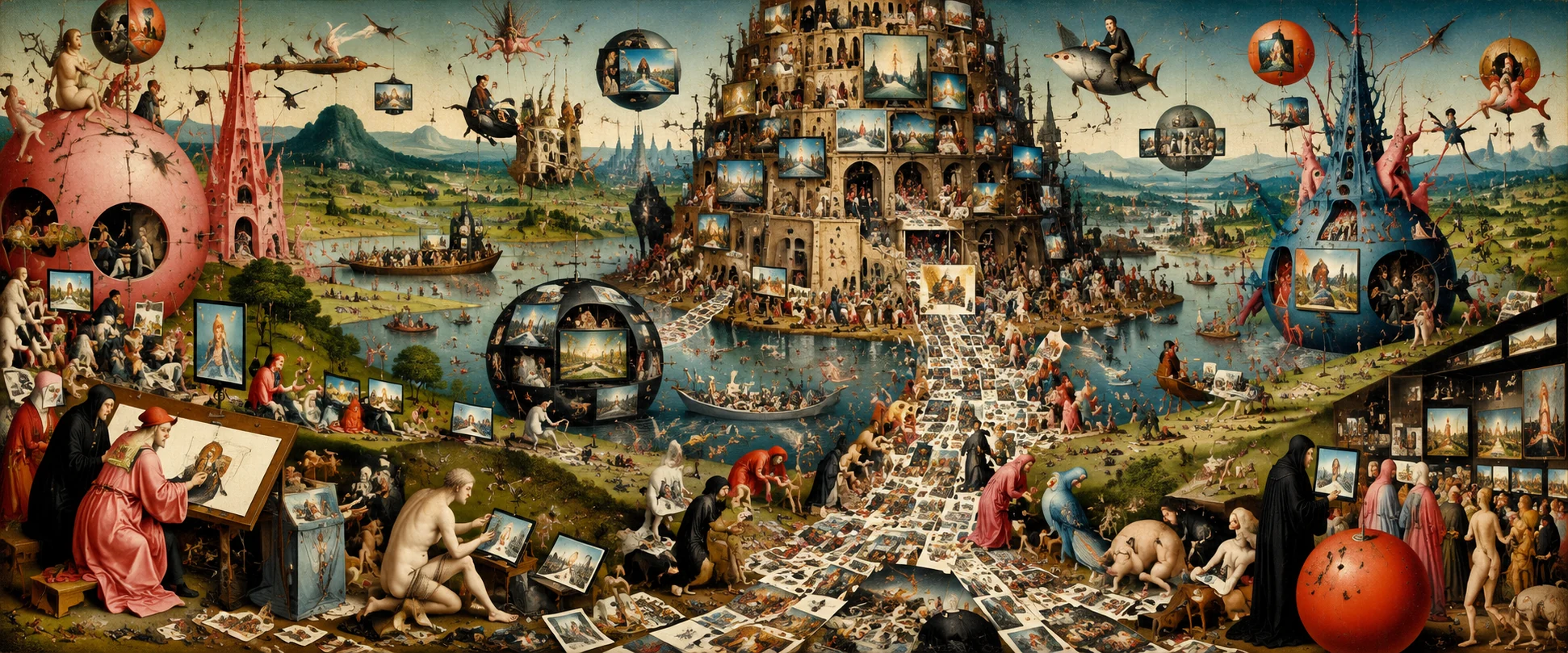
Dear Artists working today,
You’ve just come across a deeply moving poem written (you thought) by a prisoner awaiting execution but which you discover was in fact generated by a machine.
What happens to your experience of it?
It’s not like the words have changed, nor that they didn’t move to you to tears. Such a poem could still illuminate something, summon a memory or alter your whole afternoon. In other words, whatever its origins, the encounter you had with it was real.
But something did change, didn’t it? What you thought was testimony – in this case the expression of a fellow human being faced with death - turned out not to be testimony at all. The poem may remain beautiful, but it can no longer bear witness to the experience you believed lay behind it.
The mechanism at play here has something in common with ‘cancellation’. Once-admired work becomes difficult to appreciate, or even intolerable, when something objectionable is discovered about its creator. Whether and how far such discoveries should affect our response to the work remains a live question in the arts generally, and perhaps literature in particular.
We’ll come back to this in due course.
Because we bandy about terms like…well, not only ‘artist’, but also things such as ‘work’, ‘medium’, ‘audience’, ‘exhibition’ and ‘gallery’, and - while all these still obviously point somewhere – they’re intended for a world in which artefacts remained pretty much stable and people essentially navigated around them.
Strangely, the arrival of digital technology hasn’t necessarily overturned these arrangements either. Many (though not all) digital artists continue to work within that same paradigm, producing discrete works for exhibition, sale or collection - with recognisable distinctions between maker, medium, artefact and audience. There’s nothing inherently wrong with this of course, and the point isn’t that the inherited model has become invalid - merely that it no longer describes the full range of possibilities our changing culture and technologies have made available to artistic practice.
Inevitably though, these sorts of discussions immediately lead us to questions that have occupied philosophers, artists and audiences for centuries. What constitutes art in the first place? What makes it ‘valuable’, and how, by whom or through what processes is that value assigned? How does something acquire recognition as art, and how is that different from being regarded as good art? These are distinct interrogations and no answer obviously exists uncontested. And while we can't hope fully to explore – less still settle - them here, neither can we simply assume them away.
So, for the purposes of this essay, it's worth (re)stating early our position that artistic status, value and recognition aren’t necessarily properties that reside within an artefact itself. They may also arise through the relationships between makers, works, audiences, institutions and the circumstances of their encounter. The wider thinking behind that view is explored elsewhere throughout this website - and while accepting it isn’t a prerequisite for following this essay’s arguments, awareness of the position does help explain the perspective from which some of the questions that follow are approached.
Returning for a moment to the inherited paradigm however, the sheer difficulty of execution (of an artwork) has often served as a proxy for ‘artistic significance’. We may grant something ‘exceptional’ status partly because we respect the immense human labour and/or genius required, basically, to wrestle that thing into being.
Among our provocations though is that today that relationship can – and perhaps should - no longer be taken for granted. The cost of producing a flawless, professional-looking object – be that a synthetically generated canvas, a mathematically verified proof, an immaculately balanced paragraph or the completion of an unfinished Beethoven symphony - has plunged to near zero. Increasingly sophisticated systems can generate remarkable results in seconds, sometimes with very little corresponding skill on the part of the individual operating them. Thus do we swim in what might be usefully called ‘a culture of automated fluency’.
Whence – unavoidably – follows the thorny issue of ‘value’. Because once we start asking ‘what constitutes art?’ and the difficulty of producing something can no longer be taken as a reliable measure of its significance, we’re confronted with the question of why anything that does qualify should matter, to whom, to what extent and on what grounds.
But ‘value’ is neither a single nor a straightforward attribute. Something may obviously possess aesthetic value (through the qualities of the work or the experience it produces), cultural value (through its significance within a community, tradition or historical setting), economic value (through what somebody is prepared to pay for it) or personal value (through what it means to a particular individual and why). And naturally – humans being what they are – not all such valuations are innocent. Galleries, auction houses, collectors and cultural institutions routinely have considerable interests in the values they help establish and can and do actively participate in producing those values rather than merely recognising them.
But all that said, it does seem the circumstances in which artistic achievement is recognised are changing, as are the conditions under which artists' labour is valued along with the relationship between making something exceptional and persuading everybody else that it matters.
First though, it’s probably a good idea briefly to talk about ‘slop’. To begin with, what do we mean by the term?
There seem to be at least four (but probably more) definitions operating currently, these being:
- A quality judgment about generic, padded, error-strewn text or imagery that reads as low-effort filler;
- A view that insists provenance is the decisive factor – i.e. if it was made by AI then by definition it’s ‘slop’, irrespective of whatever quality;
- A volume & attention-based definition – material gets generated at such scale no reader could meaningfully keep up with it;
- Style. Prose (or images) whose manner is off-putting or recognisably machine-made, even when the underlying content has value.
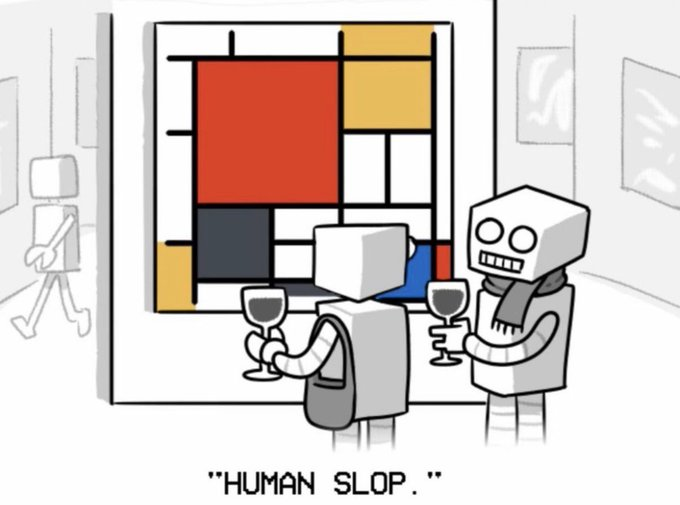
Law professors Jessica Silbey and Woodrow Hartzog propose what they no doubt consider a precise functional definition in their 2026 paper ‘AI Slop’ to wit: ‘any output of a probabilistic automated system produced with little exertion that asymmetrically burdens recipients and tends to degrade cultural domains.’ But while this captures elements of the first and third of our above definitions (low producer effort, high volume) and adds the (useful) claim the decisive harm is the externalisation of costs to recipients, it fails to address the second or fourth and leaves us with the issue of why the degree of ‘exertion’ is morally or otherwise significant (answers on a postcard wrt this please!).
Now, in fairness, Silbey and Hartzog do subsequently explain what they mean by this ‘degradation’ and identify three principal mechanisms - the crowding out of human expression, the cheapening of human effort and the introduction of errors and other deficiencies into cultural practices. But all that does is raise a further question. By what criteria do we distinguish the ‘degradation’ of a cultural domain from its (perhaps positive) ‘transformation’? The displacement of established practices, skills and relationships may well represent genuine losses without necessarily exhausting the possibilities of what gains might emerge in their place.
All in all then, we suggest the question (of ‘slop’) remains open (and philosophically profound /deserving of its own essay) as we consider the extraordinary bargain contemporary technology now offers.
A musician can produce an album without a studio. A writer can create illustrations and promotional material for their work (as publishing houses already routinely do); a painter can animate their images while a small community organisation can acquire a visual identity, marketing materials and an excellent website that might previously have cost thousands of dollars.
Projects that would once have been financially impossible therefore become achievable by people with modest resources and limited technical experience.
On the one hand, this represents an extraordinary expansion of creative possibility but on the other, developments like these aren't such good news for the graphic designer who no longer receives the commission, the illustrator whose client now generates their own images or the copywriter whose professional skills have suddenly become easier to approximate.
Now of course, not every AI-assisted production represents a lost sale. Some of these projects would never have happened without the new technologies, and some of the people using them are themselves working artists whose livelihoods are being affected in other ways.
Which raises an interesting - and doubtless, to many, uncomfortable - contradiction.
The same technologies making it possible for people, including artists, to do more for themselves also make it possible for everyone else to do more without artists.
Moreover, the distinction between beneficiary and casualty may potentially exist within the same person. (The musician who produces their own artwork may be losing commissions because somebody else can now produce their own music and the illustrator who builds their own website may find prospective clients no longer require an illustrator – and there are doubtless more tangled examples).
In any event, these new capabilities are real and so are the pressures and tensions they create.
And for some artists, there's a further and (from their perspective) particularly bitter irony which is that their own creative achievements may have contributed to the development of the technologies many are now forced to compete with.
Generative AI systems have of course been developed using enormous collections of existing cultural material, including artworks, photographs, writing and music, some of which has been used without its creators' knowledge or consent and generally without compensation.
The legality of particular training practices remains contested and varies across jurisdictions. But the ethical and economic questions don't disappear merely because the legal questions are complicated.
Thus (goes the argument) an artist may spend decades developing a distinctive practice only to discover aspects of their achievement have become part of the material through which a commercial system learns to emulate the capacities on which that artist depends for a living.
And the benefits of that system need not return to the people whose work contributed to its development.
In short, the apparent autonomy of ‘The Machine’ can obscure the accumulated human accomplishments on which its capabilities are predicated.
This then isn’t merely a dispute about whether machines can make art – it concerns ownership, consent, re-imbursement and – crucially - the conditions under which creative labour can continue to be sustained.
And those conditions are becoming more complex for yet another hugely significant reason.
Because what the democratisation of production hasn't triggered is an equivalent democratisation of attention - a stubbornly finite, non-scalable resource, probably the most valuable of all, argued here.
And it remains stubbornly finite even as the capacity to produce material competing for it expands enormously.
So as the supply of accomplished-looking artefacts increases so does the effort required to establish significance, attract attention and sustain a creative practice become considerably more demanding.
And here we encounter another particularly galling feature of contemporary artistic life.
The artist is increasingly expected to operate simultaneously as creator, publicist, editor, marketer, analyst and community manager.
A painter may spend three years developing a body of work, a musician two years producing an album or a writer devote a decade to a book. But the platforms which these days are vital to reaching an audience operate according to very different, almost oppositional rhythms.
Regular posting, rapid engagement, recognisable formats, responsiveness to trends and constant renewal are all vital components of today’s media and cultural landscape while artistic works themselves may require sustained concentration, patience, experimentation and a willingness to produce nothing publicly visible for long periods.
The distribution system usually rewards almost the opposite.
This isn’t to say algorithms invariably suppress difficult or exceptional art. On the contrary, contemporary recommendation systems can bring an unknown artist to an enormous audience almost overnight but their purpose isn’t to recognise artistic brilliance.
What they optimise for are measurable forms of engagement, and engagement can arise from all manner of things - beauty, novelty, controversy, familiarity, humour, outrage or simply the good fortune of reaching a tiny but appropriate initial audience.
But artists aren’t the only ones affected by these processes. The aforementioned audiences, too, increasingly encounter cultural material through systems that select, sequence and recommend it according to criteria that are largely invisible to them. And the consequences extend way beyond what people happen to see. The speed, volume and apparent inexhaustibility of available content may also alter how they attend to it - how long they linger, what they expect to encounter, how readily they move on and what they come to regard as worthy of their attention. A culture of automated fluency therefore doesn't merely change the conditions under which art is produced and distributed. It may also be changing the conditions under which art is experienced.
This means sometimes extraordinary work travels widely and sometimes ordinary work does. And sometimes (ok, often) sensationalism or trend-chasing performs better than painstaking artistic achievement. Not infrequently, exceptional work can go virtually unnoticed.
Put another way, the contemporary attention economy has made extraordinary visibility possible without making it predictable, equitable or reliably connected to artistic excellence.
Gatekeepers haven't disappeared but some of the gates have simply become harder to see - and even when an artist does succeed in attracting attention, yet another problem remains – that of trying to ensure initial attention becomes a sustainable artistic life.
As we all know, a musician can attract impressive streaming figures without earning enough to continue making music, an artist can build a substantial social-media following without developing a reliable market for their work and a creator can experience a viral success that produces little enduring professional benefit.
Meanwhile, somebody else can make a perfectly decent living churning out AI-generated content of questionable value (call it ‘slop’ if you like) on a daily or more frequent basis. Indeed, in an attention economy that rewards volume, novelty, familiarity and engagement, the production of disposable content can easily be a more commercially rational activity than spending months or years creating something exceptional.
There’s nothing especially mysterious about this. The systems through which cultural material acquires economic value aren’t necessarily the systems through which artistic excellence is recognised. The market for attention and the pursuit of artistic achievement are two completely different things and their rewards need not coincide. Visibility, recognition and economic sustainability are related, but they manifestly aren’t the same thing.
Nor is the problem confined to ‘the platforms’.
For many working artists, professional life consists of irregular commissions, short-term contracts, uncertain sales, unpaid preparatory work and the continuing need to find the next opportunity.
Some of course combine their artistic practice with other employment while others move between commercial and personal work often using income from one to support the other. And many eventually find that the economic conditions required to sustain their practice simply aren't there.
So, while there’s a great deal of rhetoric about the ‘democratisation of creativity’ the freedom to produce art is (and always has been) different from the freedom to devote one's life to producing it. Thus (as we’ve illustrated) an abundance of opportunity to make art doesn’t produce a concomitant abundance of opportunity to operate as an artist.
It’s a contradiction that’s becoming increasingly conspicuous – we’ve acquired extraordinary new powers of artistic production without acquiring an equivalent expansion in the means through which artists can reliably keep themselves going and meanwhile, the labour of building an audience, establishing relationships, securing opportunities and making work visible can consume more and more of the practitioner’s time.
In effect, artists are increasingly finding themselves with dual roles – (i) actually making the work and (ii) constructing the conditions in which that work can be encountered, understood, valued and sustained.
The artist must therefore increasingly become a performer of their own artistic practice.
And those activities may demand abilities that have remarkably little relationship to the abilities required to make exceptional art. A painter who spends months producing an extraordinary work may find a fifteen-second video showing its creation receives more attention and critical acclaim than the work itself.
In this way what amount to promotional artefacts may become more visible than the artistic artefacts they were intended to promote.
Which brings us to a phenomenon already alluded to but probably worth making explicit:
The cost of producing a given artefact may be falling while the cost of making that artefact matter may be rising.
Of course, ‘matter’ is doing some quite heavy lifting here - being noticed isn't the same as being appreciated and being appreciated isn't the same as achieving artistic significance and neither of those things guarantees that the artist can pay the rent.
But the increasing separation of these elements tells us something about the circumstances in which contemporary art now exists.
The problem isn't simply about the production of exceptional artefacts nor what makes them exceptional - it’s also about how such artefacts come to be recognised as such, what happens when people encounter them and what kinds of relationships allow their significance to develop.
And there's a real danger here.
We might conclude ‘artistic significance’ is simply something constructed around an artefact through marketing, reputation, curatorial endorsement or institutional association but that would be a depressing conclusion and not a particularly convincing one.
Anyone who’s encountered an extraordinary painting, piece of music, sculpture, poem or digital artwork knows that something happens.
You look at it and think: Wow. I love (or am seriously moved by) that.
Maybe you admire its extraordinary technical skill or are astonished by the artist's imagination or aesthetic judgement. Perhaps you understand exactly how the thing was made, and could conceivably produce something similar yourself yet remain delighted that someone had the foresight to make it in the first place.
Or perhaps you simply experience something that matters to you without having the slightest interest in how difficult or easy it was to produce.
Artistic excellence has never been reducible to technical difficulty and neither is it reducible to popularity, price, institutional approval or the size of an audience - but the relationship between excellence, abilities involved in producing it and the significance it acquires is becoming harder to take for granted.
And here we can return to our prisoner-poem.
As we’ve pointed out, the words didn't change when its provenance was revealed and nor did the reality of your experience. But the meaning of the encounter did change -because what you believed connected those words to the world turned out not to be true.
This doesn't establish – and nor does it claim - authorship is irrelevant or that human and machine-generated works are interchangeable -quite the opposite.
It reveals how much may depend upon the relationships between a work, its maker, its history and the person encountering it.
An exceptional aesthetic experience and an exceptional act of human testimony are not necessarily the same achievement. Nor are artistic excellence, artistic agency and artistic significance.
What a work achieves, what was required to produce it and what it comes to mean are related questions but they don’t have to have identical answers.
We’d argue some artistic meanings exist in the relationships between maker, artefact, audience and environment, rather than residing exclusively in any one of them.
None of which is new in art history. Artists, critics and philosophers have been investigating such relationships for generations.
But the circumstances in which those relationships operate are changing.
An artefact can now be reproduced, transformed, animated, recombined and circulated through systems that respond to its presence, sometimes without the knowledge or involvement of its original creator.
Crucially, the audience may become a maker, the medium a collaborator and of course the context may change while the artefact remains physically untouched.
And an encounter may become the beginning of another work.
Imagine visiting a gallery and being astonished by a sculpture or painting.
You photograph it, use a generative system to animate the image, incorporate the resulting sequence into a music video featuring a synthetic band, and distribute the video to thousands of people.
Some people encounter the sculpture (or painting) through your transformation, others discover the original artist while others still respond to the new work without ever knowing where its imagery originated.
Now, there are obvious legal and ethical questions here. Technological ease doesn't erase copyright, moral rights or the need for permission where it applies - but artistically, something interesting just happened.
The viewer has become a maker. The original artefact has become material for another practice. A machine has participated in its transformation. A synthetic performer has become part of the means through which the resulting work reaches an audience.
And the sequence needn’t end there.
An artwork may be complete as an artefact without being complete in its consequences.
Artists have always borrowed, reinterpreted, appropriated and responded to one another's work. The novelty isn't that artistic production has suddenly become relational, it’s the growing range, speed and responsiveness of the systems through which these relationships can develop.
And here's where our story starts to change direction.
Much of the discussion surrounding contemporary art and technology concerns what these systems are doing to artists.
- What happens when machines can produce accomplished imagery?
- What happens to creative livelihoods?
- What happens to authorship, provenance and the possibility of recognition?
- Etc.
These, clearly, are important questions.
But there's another question, and one that might open some seriously interesting possibilities.
What can artistic practice do to the systems in which it operates?
Art has always changed perceptions, established relationships and influenced institutions. Nothing about that is novel.
But contemporary technologies create additional opportunities for artistic propositions to enter responsive environments, produce consequences and be changed by those consequences in return.
Consider Pak's Merge, in which collectors acquired units of ‘mass’ that automatically combined within each wallet as holdings accumulated, dynamically altering the visual form of the resulting work. In this way the behaviour of participants and the mechanisms of the market were not merely external conditions of sale - they became constitutive of the ‘artwork’ itself.
Of course, whether Merge actually does constitute art in the first place is itself open to dispute. Its extraordinary commercial success establishes neither its artistic status nor its aesthetic merit. But that's a large part of what makes it interesting. Whatever judgement one chooses to make in regard to its artistic or other credentials, the piece inarguably exposes the increasingly unstable relationships between maker, artefact, audience, ownership and exchange – relationships the inherited conception of art discussed earlier has generally treated as more clearly distinguishable.
Once you begin thinking in those terms, similar possibilities can appear in very different practices:
- a performance might establish a continuing community;
- a publication might introduce a vocabulary through which people begin organising their activities;
- a fictional institution could acquire real participants and consequences;
- an exhibition might bring together works whose unexpected relationships change how audiences understand each of them;
- a generative artwork might alter its behaviour through encounters with participants, while those encounters alter the participants' subsequent behaviour.
In other words, ‘a work’ doesn't necessarily stop at the artefact and nor does its significance have to remain confined to the circumstances in which it was initially produced.
By these means then, artwork and its environment become participants in one another's evolution.
And this in turn suggests that some of the familiar distinctions between artwork, exhibition, publication, performance, experiment, institution and even business may be more contingent than we habitually assume.
Not because ‘everything is art’ and certainly not because artists should abandon the pursuit of beauty, expression, technical mastery or the extraordinary encounter in favour of becoming entrepreneurs or systems engineers. A painting doesn’t have to launch a community nor a poem alter an algorithm and a sculptor is under no obligation to construct a participatory institution.
Still though, the field of artistic action may be considerably wider than the inherited categories through which we’re given to understand it.
And there’s nothing to say excellence may not manifest within those wider possibilities too.
The ‘exceptional artist’ might be an extraordinary painter, a technically formidable generative practitioner, a remarkable composer, a creator of compelling encounters or someone whose artistic proposition establishes relationships that could not otherwise have existed.
These are not mutually exclusive achievements, nor are they necessarily confined to particular media.
Consider a painter investigating what physical presence means in a culture saturated with synthetic imagery and a generative artist investigating the relationship between machine agency, authorship and aesthetic experience.
Their practices probably look nothing alike and their techniques have little in common yet they may be investigating closely related questions.
A novelist exploring the agency of fictional characters might discover an unexpected relationship with an artist constructing autonomous software entities; a sculptor concerned with the relationship between object and environment might share an inquiry with an artist whose work changes through audience participation.
A curator might bring such practices together and establish a context in which their relationships become visible for the first time.
What if some of the most productive relationships between contemporary artists are no longer necessarily those established by shared media, technologies or aesthetic styles?
What if artists could find intellectual peers through the questions they investigate, rather than merely through the materials they use?
None of that would require anyone to abandon their discipline, reject their artistic history or subscribe to a new technological orthodoxy, it might simply reveal possibilities that weren't apparent while the practices remained confined to their familiar categories.
A collaboration, exhibition, publication, shared experiment, encounter that changes the direction of somebody's work. Or something larger still.
Artistic movements have always done more than describe the work of their participants.
They’ve brought artists into relationships, established vocabularies, challenged assumptions, created audiences and generated contexts through which individual practices acquired new significance. Movements have lent significance to the artist; the artist lent substance to the movement and the relationship was reciprocal.
Which raises quite an intriguing possibility.
What if an artistic formation were organised not around a common aesthetic, technology or medium, but around a shared willingness to investigate the changing conditions of artistic practice itself?
It might begin with a question:
What becomes of art when the systems producing and organising reality are changing faster than our ability to represent them?
In this scenario – and given all we’ve discussed previously - the concern might be with what artistic practice might become in an environment that’s increasingly participatory, recursive, networked, synthetic and populated by forms of non-human agency.
Propositions might be offered as things to investigate through creative practice, rather than doctrines to which practitioners need to subscribe.
A painter needn’t become a programmer nor a musician a systems theorist or a sculptor abandon the physical object.
The Manifesto presented on this website is not simply a statement of beliefs but an artistic intervention in its own right. Its Hyperstitional Seed explores the possibility that a proposition, once introduced into circulation, can help bring about some of the conditions it anticipates. Other experiments investigate what happens when distinctions between tool, maker, collaborator and audience become uncertain.
These are beginnings, not demonstrations of a completed theory.
Indeed, a formation concerned with distributed agency and recursive processes would contradict its own premises if it arrived already finished, with its meaning and future determined in advance.
Participants in such a project would not and should not merely demonstrate something already believed, they must be able to change what it becomes.
Because the contemporary artist's predicament is not simply that extraordinary artefacts are becoming easier to produce while the conditions through which they acquire recognition and significance are becoming more difficult to navigate – it’s that those conditions themselves may be becoming available as material for artistic practice.
The relationships between works, makers, audiences, institutions, technologies and environments need not be understood merely as circumstances artists must endure.
They may also become things artists can investigate, challenge, construct and transform.
And they need not do so alone.
The exceptional is not disappearing. The conditions under which it is produced, recognised and made consequential are changing.
What might artists discover if they began to treat those conditions not simply as the environment in which their work must survive, but as part of the territory in which their work could act?