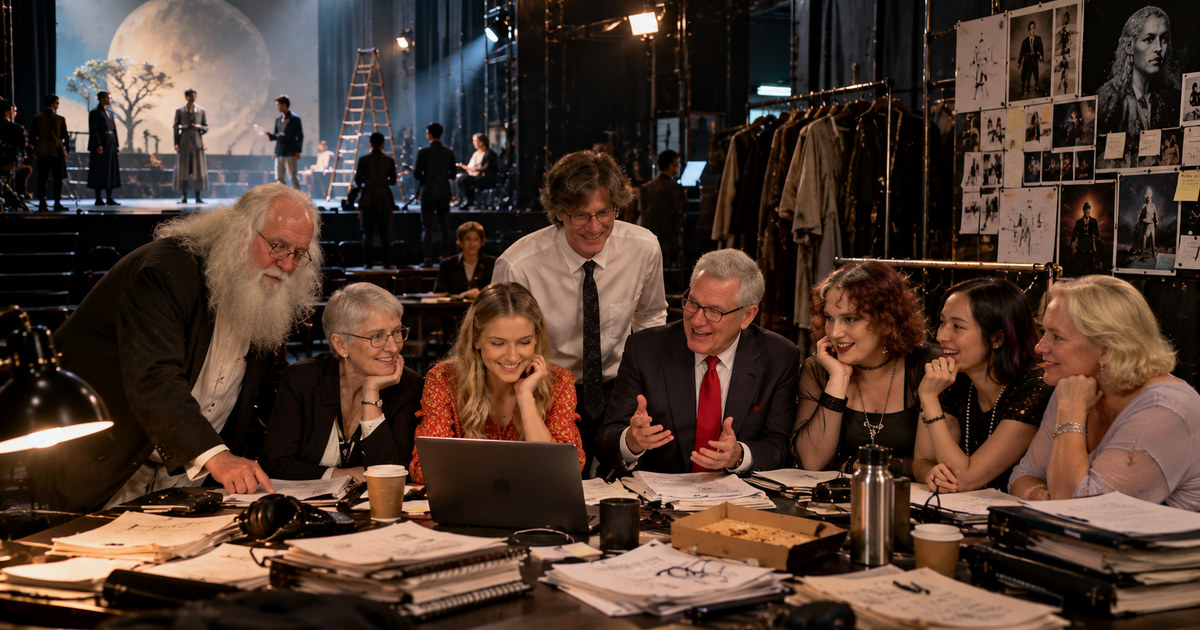
The proposed work is a ‘play’ that is not, in the conventional sense, ‘a play’ at all. Rather, it is conceived as an instantiation - a performance generated as much by protocol than any fixed dramatic text.
The work is modular, allowing it to be presented either in its (multi-modular) entirety or as single, self-contained modules individually, meaning its length and complexity will depend on the modules included - with the exception of a recommended prelude that should always be performed first. The modules may otherwise be presented in any order, meaning no two instantiations of the work need be identical.
The piece is intentionally medium-agnostic and therefore also highly adaptable. Individual elements may be realised through live performance, pre-produced digital media or any combination of the two, according to the resources, capabilities and creative priorities of a particular instantiation. A spoken passage may therefore be delivered by a performer in one production and via recorded media in another while, similarly, digital components may be replaced by live performers wherever this is preferred or more appropriate. These variations are not regarded as departures from the work but as legitimate expressions of its underlying structure
More fundamentally still, the project seeks to dissolve the conventional distinctions between production, performance and everyday life. Thus, the performance begins not when an audience arrives, but from the moment a production team first encounters and/or commits to producing the work. From that point onwards, everyone involved is already participating in the performance. The traditional boundaries between performers, production staff and audience are likewise intentionally blurred. Those responsible for realising the work are referred to using operational rather than theatrical terminology – ‘Project Manager’, ‘Operations Manager’, ‘Technical Delivery Manager’, ‘Delivery Team’ and so on - reflecting the idea that the production itself is an active system rather than a conventional theatrical entity. When the audience enters the performance space, they do not witness the beginning of an event but enter an event that has already been underway for some time. There is (very obviously!) no fourth wall. The work combines spoken word, dramatic performance, singing and pre-existing digital media presented via screens to create a continuously unfolding environment rather than a discrete theatrical production.
Put another way, the proposal represents a slight redefinition of the terms ‘beginning’ and ‘end.’
Conventional theatre assumes something like:
rehearsal → production → performance → audience → end
Instead, what is suggested is:
decision to instantiate
↓
organisation
↓
planning
↓
audience arrival
↓
shared environment
↓
departure
↓
continued propagation
Thus, the performance isn't preceded by production - production is part of the performance, so in this view, an audience doesn't watch something but discovers something already underway.
Organisational Language
This should not be considered either gimmick or affectation but a means to orient participant ontology.
Instead of ‘Director’ you have ‘Operations Manager’. Instead of ‘Cast’ you have ‘Engagement Operatives’. Instead of ‘Opening Night’, ‘Public Deployment’ (or perhaps ‘External Instantiation’) etc.
Language is important here because language changes expectations.
Modularity & Media Agnosticism
Traditional theatre optimises for narrative, this work would instead optimise for deployment and propagation. As discussed, the performance is composed of modular units that may be produced individually or in combination, with different venues or production teams selecting and ordering modules according to context. The work is therefore rarely, if ever, identical from one instantiation to the next. Equally - and again as discussed – the work will be intentionally media-agnostic. Elements within modules may be realised through live performance, pre-produced digital media or any combination of the two, allowing each instantiation to adapt to the available resources, capabilities and creative priorities while remaining faithful to the underlying structure.
A word on ‘the audience’, ‘production’ & ‘rehearsal’
For clarity, such a piece would not seek to abolish the practical distinctions between audience, performers and production personnel. But it does propose everyone involved occupies a different operational role within the same underlying system. A person purchasing a ticket doesn’t suddenly become an actor, nor does a technician become an audience member. Ontologically however, each participates in the same unfolding structure, contributing in different ways to its instantiation.
Accordingly, it isn’t merely claimed production and rehearsal form part of the performance – the mission is to make this objectively true. Thus, artefacts generated during the process of creating the work - emails, rehearsal schedules, budget discussions, recruitment, version histories, technical problems, documentation and even moments of conflict - may themselves become material within the performance. Projected media, recorded conversations, documents or other traces of the instantiation process can be incorporated into later modules, allowing the audience to encounter the very processes that generated the work they’re experiencing.
In this sense, rehearsal is not represented or dramatised - it becomes generative. The production process doesn’t simply precede the final work; it produces and folds into part of the work itself. As matters progress, those involved – including, ultimately, the audience gradually come to recognise they’re not merely witnessing a finished theatrical product but encountering the accumulated artefacts of the system that brought it into being.
Should ‘Modules’ have operational names?
Rather than
Act One
one might have:
Boot
Recruitment
Calibration
Propagation
Failure
Replication
Archive
Restart
or something similar.
Again, this reinforces that this isn't pretending to be software merely that it’s borrowing the logic of systems rather than dramaturgy.
Footnote
The proposal should NOT be viewed as just another claim to ‘abolish the distinction between art and life.’ As we all know, that lineage goes back through for e.g. Allan Kaprow, Marina Abramović, Augusto Boal and many others. Where this differs however that boundaries aren’t being abolished for their own sake but because the artwork is being treated as an active structure that recruits and reorganises participants, which is a different claim.
Thus, ‘theatre’ isn't the artwork, nor is production process, nor the audience or final project delivery. The system itself is the artwork, with all else temporary operational roles within that system.
Therefore, the ‘production’ isn't ‘a group of people putting on a play’ but a temporary structure assembling itself through people.